
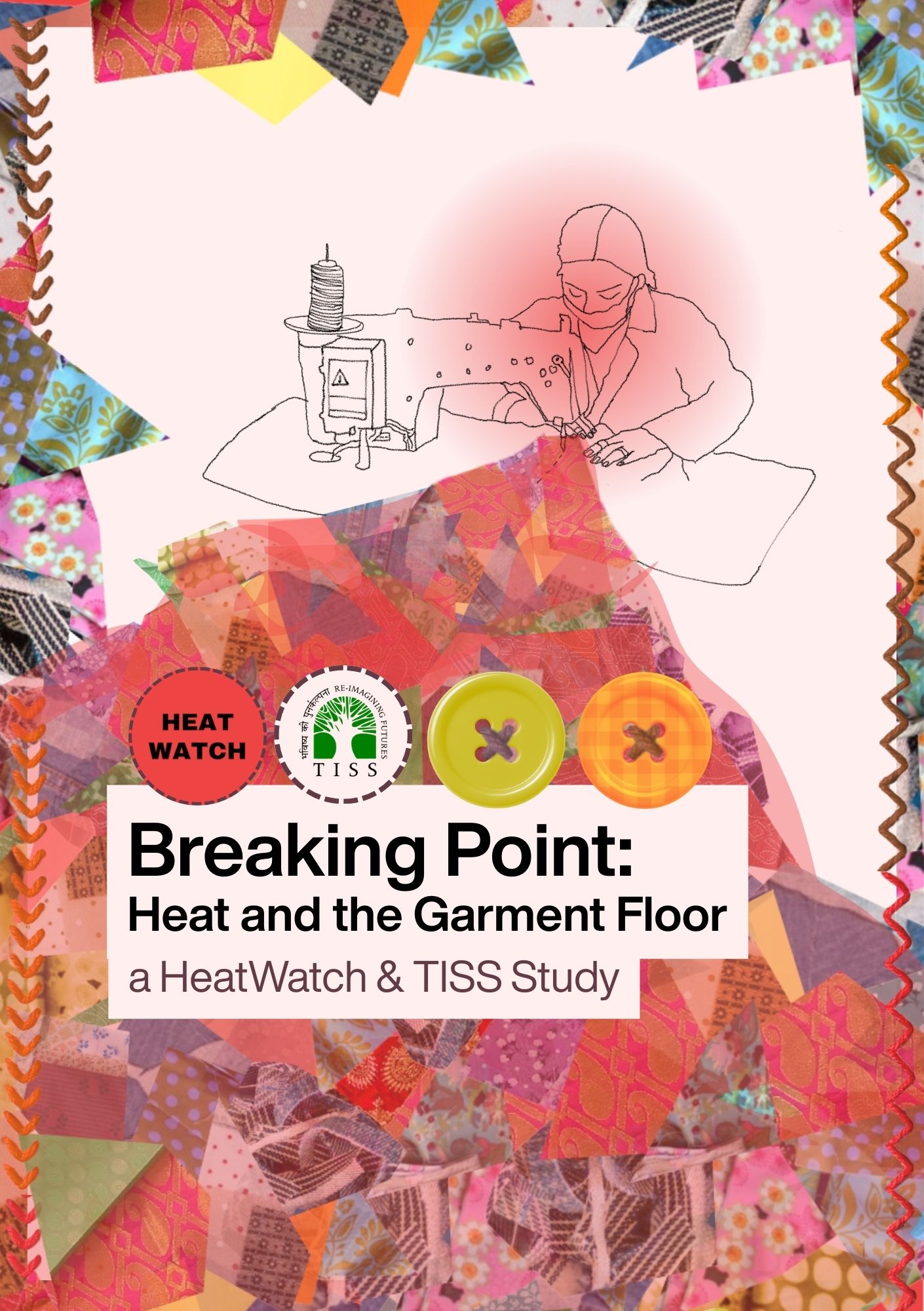
Breaking Point: Heat and the Garment Floor
Temperatures across the globe are rising sharply, transforming heat from a silent disaster into a central climate and public health crisis. The impacts on human health range from heatstroke deaths to several long-term cardiovascular, renal, mental health and other impacts. Not just human health, India could lose the equivalent of 35 million full-time jobs and experience a 4.5% reduction in GDP by 2030 due to heat stress (ILO, 2019).
The textile and garment sector in India, which employs around 45 million people (Ministry of Commerce & Industry, 2025), is especially vulnerable, given its dense factory settings and pressure from fast fashion timelines. Garment workers, 70% women (FEMNET, n.d.), are especially vulnerable to heat stress due to several workplace hazards from cramped workstations, poor ventilation, inadequate lighting (Rana et al., 2021) to impossible production targets.
The report titled Breaking Point: Heat and the Garment Floor by HeatWatch and Tata Institute of Social Sciences, Mumbai, documents how extreme heat is shaping the daily lives of garment workers and exposing major gaps in workplace protections. Based on an extensive survey with 115 garment workers in Tamil Nadu and Delhi-NCR and
Based on an extensive survey of 115 garment workers in Tamil Nadu and Delhi-NCR and 47 in-depth interviews, this report shows how heat interacts with high work pressure, workplace abuse, and gendered power dynamics. Beyond the factory walls, the report captures heat stress experiences of sub-contracted home-based garment workers based on a focus group discussion with 9 women workers in Delhi-NCR. This report also holds factory case studies based on survey with supervisors and managers across 15 garment and textile factories in Tamil Nadu, Delhi-NCR, and Gujarat to understand workplace conditions such as access to drinking water, toilets, ventilation, as well as the nature of working hours, production pressure, and piece-rate payment systems.
Findings
The survey reveals that the workers cannot access the cardinal protections against heat stress:
36.5% workers reported that though water is available on the factory floor, it often runs out or is not clean.
78.3% workers reported that it is difficult to get permission to use the toilets.
80% also reported that there is no air movement at their workstations and the air feels hot and stuffy.
The resulting health impacts of heat are grave:
68.7% workers reported that heat affected their ability to work.
87.8% workers reported feeling completely drained at the end of the day during peak summer months.
87% workers reported that in the last 12 months, they faced heat-related issues such as headache, dizziness, weakness, and muscle cramps.
78% of workers skip breaks to meet targets. Those who skip breaks have nearly double the stress scores of those who do not. While 79.1% of workers reported that they have fixed break times, it is difficult to take an extra break even if they feel tired or hot.
96.8% of female workers reported a burning sensation during urination.
92.6% of women reported disruptions to their menstrual cycles or increased pain, correlating with extreme production pressure.
Heat Stress as Business Risk
Protecting workers from heat stress is a labour rights imperative, but it is also inseparable from business responsibility and the long-term sustainability of the garment sector. The textile and garment sector in India employs around 45 million people (Ministry of Commerce & Industry, 2025)and is especially vulnerable to heat stress, given its dense factory settings and pressure from fast fashion timelines. In FY 2023–24, India exported textiles and apparel worth $35 billion (Ministry of Commerce & Industry, 2025). Given its national significance, it is crucial to pay close attention to the textile sector’s exposure to heat impacts and to develop appropriate protection and adaptation policies to safeguard workers and sustain productivity.
Our survey with 15 garment and textile units in Tiruppur (Tamil Nadu), Faridabad, Gurugram and Noida (Delhi-NCR), and Surat (Gujarat) revealed massive gaps in provisions of basic infrastructure in factories:
60% of the surveyed factories do not have any medical clinic or doctor. Only 6 factories (40%) have an on-site clinic and medical officer. Out of these, 20% do not have a full-time doctor. Most factories reported that they informally train workers to deal with medical emergencies.
11 out of 15 (73.3%) factories have roofs made of metal or asbestos.
7 out of 15 factories have no devices to capture temperature or humidity. The remaining 8 that do capture temperature do not take any measures to revise work schedules or adjust work based on extreme heat.
Moreover, workers in 4 out of the 7 factories report that devices used to measure temperature are only installed during buyer visits or inspections.
Recommendations
The experiences of garment workers in this study make clear that extreme heat is not merely uncomfortable but a daily reality determining health, mental well-being, productivity, and livelihood. Yet existing workplace regulations and climate responses remain poorly equipped to address the risks faced by indoor factory workers. The recommendations emerging from this report therefore call for a comprehensive approach that moves beyond short-term coping measures toward structural change. They emphasize the need to recognize heat as a labour and public health issue, strengthen workers’ rights and income security, and transform factory environments to make them safer under rising temperatures.
Legal Recognition & Social Protection for Heat Risks
Expand the definition of what is a heatwave using a graded classification system and comprehensive temperature thresholds like Wet Bulb Globe Temperature or Universal Thermal Climate Index (UTCI) to address heat stress among indoor workers who work in high temperatures.
Recognize heat stress and heat morbidity as occupational diseases.
Include heat stress in the Employees’ State Insurance Act, 1948 and extend coverage under the Employees’ Compensation Act, 1923.
Treat extreme heat as ‘force majeure’ in labour laws and brand–manufacturer agreements.
Strengthen the factory inspectorate and conduct surprise inspections.
Shift the burden of proof to suppliers to ensure that manufacturing units meet international occupational health and safety standards.
2. Worker Rights, Income Security & Collective Power
Extend the right to remove oneself from work during extreme heat without penalty.
Provide a Heat Hardship Allowance when temperatures exceed safe thresholds to compensate workers for the physiological toll of extreme heat.
Extend the right to unionize and strengthen collective bargaining.
Mandatory worker participation in heat risk assessment and establishment of joint worker-management safety committees to decide work-rest cycles.
3. Factory Infrastructure and Workplace Provisions
Mandate work–rest cycles, self-pacing, and rescheduling during heatwaves as per ILO’s recommendation (Flouris et. al., 2024).
Ensure adequate workplace amenities: rest spaces, drinking water, hygienic washrooms, and PPE and uniforms redesigned for thermal comfort to the workers.
Adopt infrastructural and engineering solutions including alternative building materials, active ventilation, evaporative cooling, improved roof design, and local air-cooling systems, to reduce heat stress among workers.
Train supervisors and factory management to identify early symptoms of heat stress and prioritize on-site cooling and first-aid response.
Read the report here
Related Reports
On Call in a Burning City: How Extreme Heat Is Reshaping Women’s Platform Work in Delhi NCR
HeatWatch's latest report explores how extreme heat is affecting the health, livelihoods, and working conditions of women platform workers in Delhi NCR, and why heat must be recognised as a labour, gender, and public health issue.

Rising Heat and Waste Workers: Impact of Heat Stress on the Livelihood and Health of Waste Workers in Bengaluru
Heatwatch and Hasiru Dala have launched a new report exploring the growing threat of extreme heat in Bengaluru and its disproportionate impact on waste workers.
HeatWatch's 2025 Report Reveals Undercounted HeatStroke Deaths and Urgent Gaps in Public Health Response
In stark contrast to official figures reporting just 14 confirmed heat-related deaths in India between March and June 2025, this report documents 84 suspected heatstroke-related deaths. These findings were compiled from a systematic review of media reports across national and regional languages, using both AI-assisted searches and manual data collection to capture local coverage likely missed by government estimates.