
Report
HeatWatch's 2025 Report Reveals Undercounted HeatStroke Deaths and Urgent Gaps in Public Health Response
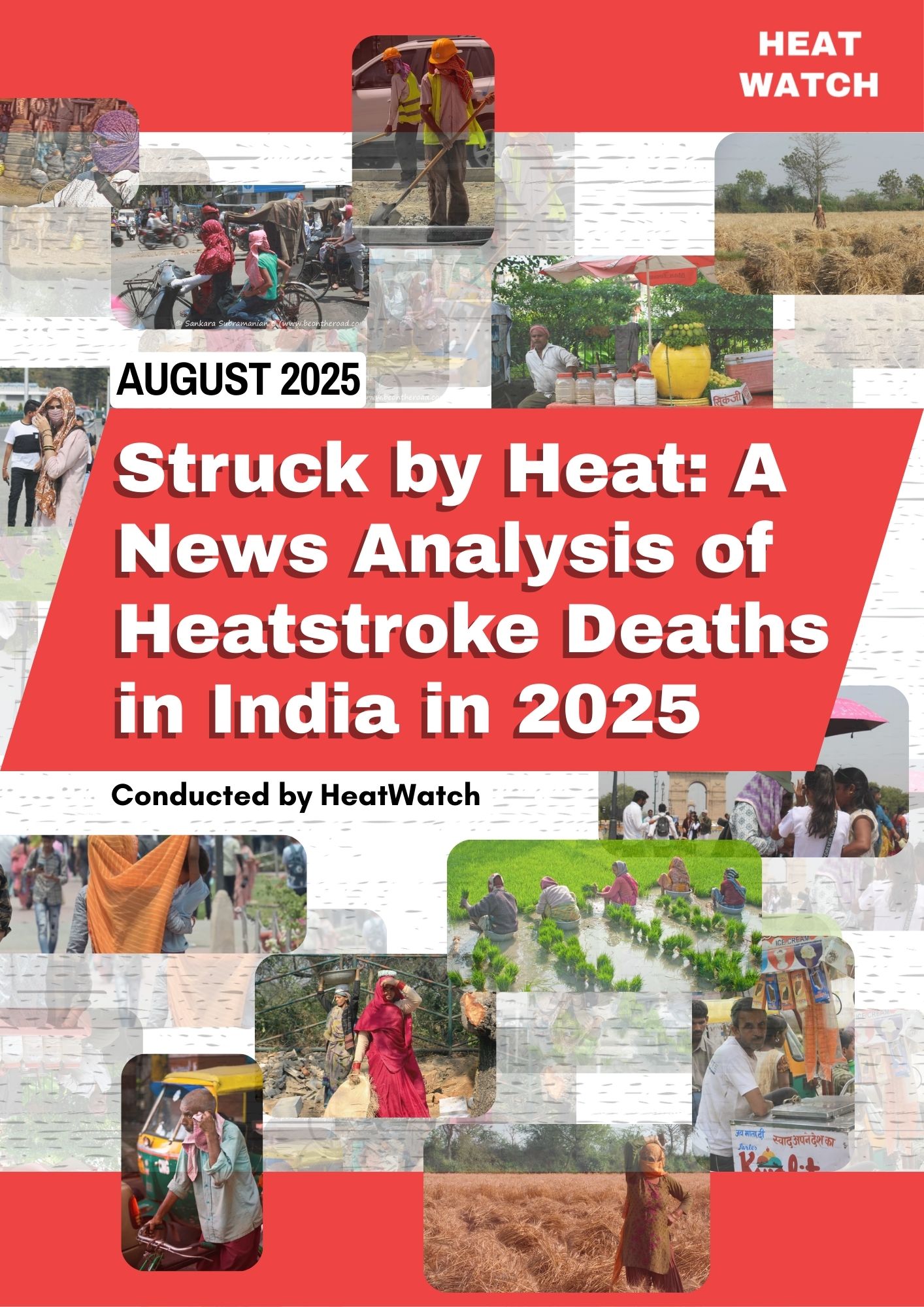
A new report by HeatWatch reveals that India’s 2025 summer has been dangerous with at least 84 suspected deaths reported by media between February and July. In comparison, according to data obtained by PTI under the Right to Information (RTI) Act, the National Centre for Disease Control (NCDC) said that India reported 7,192 suspected heatstroke cases and only 14 confirmed deaths due to extreme heat between March 1 and June 24 this year. The findings of “Struck by Heat, A news analysis of Heatstroke deaths in India 2025” underscore how rising temperatures and humidity, now spreading to regions historically-less affected, including Assam. are turning extreme heat into a nationwide public health crisis.
Urgent Gaps Exposed
Undercounting heat deaths: India’s official figures remain misleadingly low due to diagnostic blind spots. Although new national forensic guidelines allow autopsies to classify heatstroke as a cause of death even without direct temperature records, these protocols remain poorly known and rarely applied by doctors and pathologists. As a result, many cases are written off as “cardiac arrest” or “stroke,” erasing heat’s role.
Flawed heat warnings miss lethal conditions: India Meteorological Department (IMD) heatwave alerts are based almost exclusively on temperature thresholds and exclude Wet Bulb Globe Temperature (WBGT), which measures the combined danger of heat and humidity. This leaves millions at risk in coastal and high-humidity regions where health stress rises well before official alerts are triggered.
Deaths occurring even on days when IMD did not issue heatwave warnings or red alerts: The report documents multiple instances where fatalities occurred on “non-alert” days — with workers collapsing in Telangana, Gujarat, and Maharashtra despite no official warnings.
Hospitals struggle, workers unprotected: Even when guidelines exist, implementation lags due to lack of training for doctors or availability of life-saving equipment in hospitals. Outdoor and informal workers, who make up over 90% of India’s workforce, continue to work in peak sun without mandatory breaks, shade, or cooling access, despite recommendations from disaster authorities.
Global Context & Missed OpportunitiesWhile countries such as China, France, and Singapore have adopted health-based early warning systems and mandatory workplace protections through legislations and penalties, India’s official heatwave alerts remain tied to outdated temperature-only thresholds. This mismatch contributes to what experts call a “silent undercount” of heat stress across the country.
Recommendations
The report urges policymakers to:
Ensure Every Heatstroke Case is Counted – Expand training and support to hospitals and clinics to report all heatstroke and severe heat exhaustion cases to a centralized, publicly available registry to ensure no cases go unrecognized.
Unify Heat Data Under One Open System – Integrate weather, health, and mortality data into a single national, open-access monitoring platform (unlike the closed IHIP system), enabling researchers, civil society, and policymakers to accurately track and respond.
Issue Health-Based Heat Alerts – Move beyond dry bulb temperature warnings and adopt WBGT and Heat Index measures that better reflect real health risks for coastal cities, dense urban centers, and outdoor workers.
Protect Workers With Enforceable Laws – India must implement national legislation mandating work-rest cycles, shaded rest areas, hydration access, and legally enforce mid-day work bans during severe heat, bringing its protections in line with France, Japan, and the UAE.
“This summer has shown us that India’s heat crisis is structural, not just seasonal. Early-warning and alerts are limited and offer no real protection to workers who are collapsing in fields, markets, and construction sites without protections. Our report makes clear that incremental fixes won’t cut it. We urgently need robust, hyperlocal monitoring and effective early-warning systems coupled with enforceable worker protections so that this cycle of preventable loss does not repeat in the next summer,” Apekshita Varshney, Founder, HeatWatch, and report co-author, said “We are recognising the dangers of rising heat, but recognition alone isn’t enough. What’s missing is a health-centered approach, one that counts every case, prepares hospitals, protects workers, and builds cooler cities. These systemic steps are what will truly save lives in a warming climate,” Shivani Das, report author, said.
TO read the report, click here.
To browse the data, please click here.
Related Reports
On Call in a Burning City: How Extreme Heat Is Reshaping Women’s Platform Work in Delhi NCR
HeatWatch's latest report explores how extreme heat is affecting the health, livelihoods, and working conditions of women platform workers in Delhi NCR, and why heat must be recognised as a labour, gender, and public health issue.
Breaking Point: Heat and the Garment Floor
This report by HeatWatch in collaboration with the Tata Institute of Social Sciences, Mumbai, is based on our research with 115 garment factory workers in Tamil Nadu and Delhi and interviews with factory management across 15 garment and textile units in Tiruppur in Tamil Nadu, Faridabad and Noida in Delhi-NCR, and Surat in Gujarat to establish a baseline of physical infrastructure, operational policies, and health and safety systems.

Rising Heat and Waste Workers: Impact of Heat Stress on the Livelihood and Health of Waste Workers in Bengaluru
Heatwatch and Hasiru Dala have launched a new report exploring the growing threat of extreme heat in Bengaluru and its disproportionate impact on waste workers.