
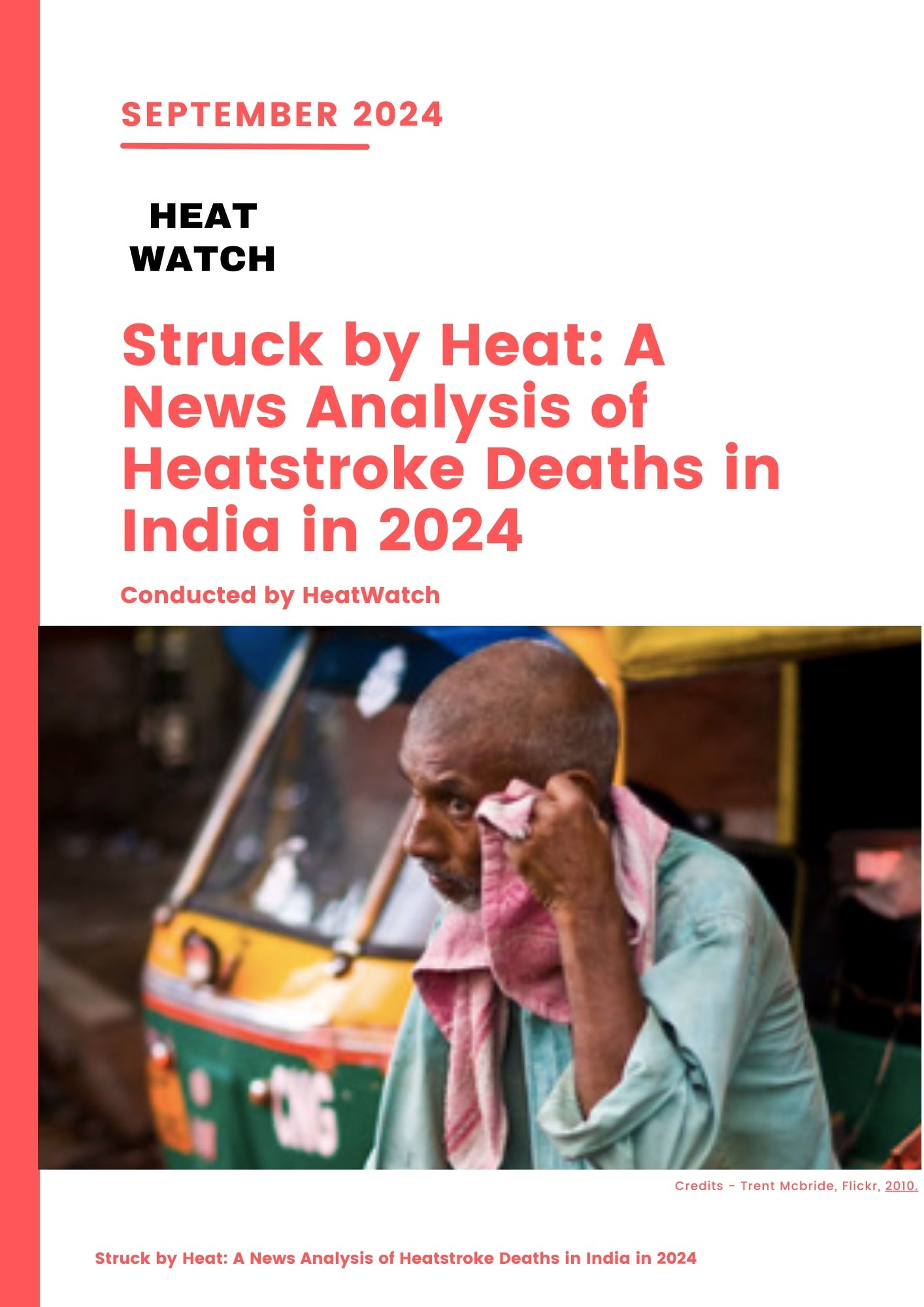
Heatwaves are becoming increasingly frequent, deadly and intense in India, with 37 cities reporting high temperatures of over 45 degrees Celsius. There have been over 40,000 heat stroke cases in India due to soaring temperatures and at least 110 confirmed deaths. Despite news media’s role at being at the forefront of reporting heatstroke deaths in India between March and June 2024, discrepancies exist between the heat stroke death figures reported by the media and the government.
HeatWatch and Veditum India Foundation conducted an online data sprint or data gathering exercise on July 27, 2024, to investigate the discrepancies in data reported by news articles on heat stroke fatalities versus the data released by government authorities. HeatWatch has come out with the report titled “Struck by Heat: A News Analysis of Heatstroke Deaths in India” which highlights the findings from the data sprint.
HeatWatch found that between March and June, there have been 733 deaths due to heatstroke in 17 states in India. The data presented by the Ministry of Health and Family Welfare in the recent Lok Sabha session, however, highlights that for these 17 states, there have been 360 deaths between March 1 and July 25.
HeatWatch also examined the implementation of three guidelines issued by the National Programme on Climate Change & Human Health (NPCCHH) and National Centre for Disease Control (NCDC) to mitigate heat wave risks - the 2021 National Action Plan on Heat-related Illnesses, the 2024 Emergency Cooling on Severe Heat-related Illnesses and the 2024 Autopsy Findings in Heat-related Deaths. While the mechanisms outlined in these guidelines are important in handling heat-related illnesses, there are gaps on ground which hinders the implementation process. For instance, hospitals in India do not yet have the facilities and infrastructure to fight the deadly heatwaves. Additionally, many doctors and healthcare professionals are unaware about the existence of such guidelines.
This has also led to the overlooking of certain measures. For instance, during any mass gathering event during extreme heat waves, the central and state governments are required to set up a heat desk (which includes access to water, an ambulance and an air-conditioned indoor facility), on-site cooling equipment, and ensure other post-cooling requirements. During the 2024 Lok Sabha Elections, these were ignored resulting in avoidable heat-related illnesses and heat strokes, including the death of at least 33 polling officers due to heatstroke in Uttar Pradesh.
The recent NCDC advisory emphasizes that the State governments must ensure enthusiastic adoption and implementation of the Integrated Health Information Platform (IHIP) - an online portal developed to maintain a comprehensive public repository of state-wise data on heat-related deaths and illnesses in India. However, what is concerning is that this portal has not been made transparent, accessible and open to the public.
HeatWatch has the following recommendations to monitor accurate heatwave deaths and support mitigation and adaptation strategies.
1. Identifying, analysing and implementing local temperature thresholds.
2. The Integrated Health Information Platform (IHIP) should be made public with transparency on data collection protocols and methods.
3. Wider implementation of the guidelines outlined in the National Action Plan on Heat-related Illnesses especially on mass gatherings and public events.
4. Capacity-building Training for all healthcare workers and doctors.
5. Increased funding for heat action plans (HAPs).
To read the report, please click here
Related Reports
On Call in a Burning City: How Extreme Heat Is Reshaping Women’s Platform Work in Delhi NCR
HeatWatch's latest report explores how extreme heat is affecting the health, livelihoods, and working conditions of women platform workers in Delhi NCR, and why heat must be recognised as a labour, gender, and public health issue.
Breaking Point: Heat and the Garment Floor
This report by HeatWatch in collaboration with the Tata Institute of Social Sciences, Mumbai, is based on our research with 115 garment factory workers in Tamil Nadu and Delhi and interviews with factory management across 15 garment and textile units in Tiruppur in Tamil Nadu, Faridabad and Noida in Delhi-NCR, and Surat in Gujarat to establish a baseline of physical infrastructure, operational policies, and health and safety systems.

Rising Heat and Waste Workers: Impact of Heat Stress on the Livelihood and Health of Waste Workers in Bengaluru
Heatwatch and Hasiru Dala have launched a new report exploring the growing threat of extreme heat in Bengaluru and its disproportionate impact on waste workers.